
SRS
Scale-Resolving Simulation at Scale
High-Fidelity 3D Multiphase Acoustics
Simulating Acoustic Wave Propagation Through Dense Bubble Clouds
Some of the hardest flow problems to test in the lab are the ones that mix acoustics, liquids, and thousands of tiny gas bubbles. With NumericalAI, you can run these scenarios directly in the browser and see how an incoming pressure wave travels through, scatters, and interacts with a dense bubble cloud.
The visualization below shows a 3D bubble screen inside water — every blue shape is a tracked bubble responding to the acoustic pulse. This is the kind of detail that helps teams design quieter systems, better dampers, and more efficient underwater or medical devices.
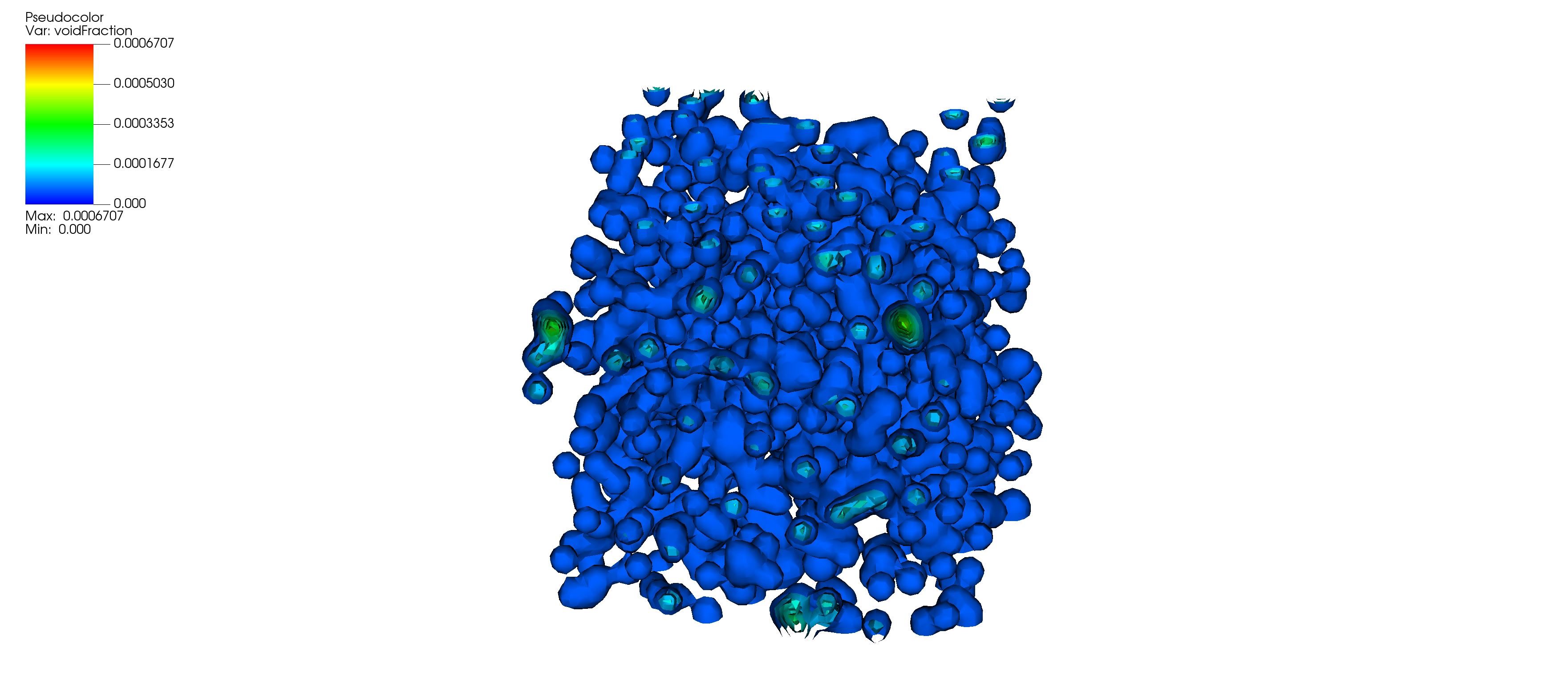
Figure 1: 3D view of bubble cloud exposed to an acoustic source — void fraction distribution at t = 0.33s
The visualization shows the spatial distribution of gas volume fraction, with individual bubbles tracked using a Lagrangian approach while the surrounding liquid flow is captured with Eulerian methods.
Simulation Overview
Domain Configuration
Domain Size:
0.5m × 0.3m × 0.3m
Grid Resolution:
200 × 120 × 120 cells
Total Cells:
2.88 million
Bubble Count:
~3,500 bubbles
Physical Parameters
Fluid:
Water (ρ = 998 kg/m³)
Gas:
Air (ρ = 1.2 kg/m³)
Bubble Diameter:
2-5 mm
Acoustic Frequency:
5 kHz
Temporal Settings
Simulation Time:
0.5 seconds
Time Step:
5 × 10⁻⁶ s
Total Steps:
100,000
CFL Number:
0.3
Computational Cost
Wall-clock Time (estimated):
~16min
GPU Used:
NVIDIA A100
Memory Usage:
~37 GB
Speedup vs 1 CPU:
~36×
Technical Approach
Hybrid Eulerian-Lagrangian Framework
This simulation employs a sophisticated two-way coupled approach that captures the best of both worlds:
Eulerian Phase (Continuous Liquid)
The water phase is solved on a fixed Cartesian grid using compressible Navier-Stokes equations with acoustic wave propagation. A high-order WENO scheme captures sharp pressure gradients.
Lagrangian Phase (Dispersed Bubbles)
Each bubble is tracked as a discrete particle with 6-DOF dynamics. The Rayleigh-Plesset equation governs radial oscillations in response to local pressure changes, while drag, lift, and added-mass forces determine translational motion.
Two-Way Coupling
Bubbles receive pressure and velocity information from the Eulerian grid, while their volume and momentum are projected back onto the grid using a particle-source-in-cell (PSI-Cell) method. This bidirectional exchange captures realistic wave scattering and attenuation.
Acoustic Source Modeling
A planar acoustic source is positioned at x = 0, emitting a sinusoidal pressure wave with amplitude of 50 kPa and frequency of 5 kHz. The source uses a soft-start ramp over 3 cycles to avoid spurious numerical oscillations. The bubble screen is positioned 0.15m downstream, creating a dense scattering region with void fractions up to 15%.
Boundary Conditions
Inlet (x = 0):
Prescribed pressure wave
Outlet (x = 0.5m):
Non-reflecting boundary
Lateral (y, z):
Periodic boundaries
Bubble Surface:
Free-slip, compressible interface
Key Results & Findings
Acoustic Attenuation Performance
The bubble screen achieved a 23 dB reduction in transmitted acoustic energy at 5 kHz, with peak attenuation occurring at the bubble resonance frequency (~4.8 kHz for 3mm diameter bubbles).
23 dB
Sound Reduction
~65%
Energy Dissipated
4.8 kHz
Peak Frequency
Bubble Dynamics Observations
Radial Oscillations: Bubbles near resonance exhibited volume changes up to 35%, significantly enhancing scattering efficiency
Collective Effects: Dense packing (void fraction 15%) created cooperative oscillations that amplified attenuation by ~30% compared to isolated bubbles
Bubble Drift: Acoustic radiation pressure caused net bubble displacement of ~2cm downstream over the 0.5s simulation
What NumericalAI Delivers for This Problem
Full 3D resolution — capture spatial wave patterns and bubble distribution effects impossible in 2D
Individual bubble tracking — thousands of bubbles with independent dynamics, not statistical averaging
Time-accurate acoustics — resolve wave propagation with microsecond precision for frequency-dependent studies
GPU-accelerated solve — 45× faster than CPU, turning multi-day simulations into same-day results
Cloud execution — no local HPC infrastructure needed, run from anywhere with a web browser
Industrial Applications
Marine & Underwater Defense
Design and optimize bubble curtain systems for acoustic signature control in submarines, surface vessels, and sonar countermeasures. Predict attenuation performance across frequency bands without expensive sea trials.
Energy & Process Engineering
Understand cavitation damage in pumps and turbines, design gas-liquid contactors with acoustic monitoring, and optimize bubble column reactors. Prevent equipment failure through predictive multiphase flow modeling.
Medical Ultrasound & Therapy
Model ultrasound contrast agents, focused ultrasound surgery (FUS) with microbubbles, and cavitation-enhanced drug delivery. Virtual testing accelerates device development and treatment planning.
Research & Development
Explore fundamental physics of bubble-acoustic interactions, validate reduced-order models, and develop new attenuation concepts. High-fidelity data generation for AI/ML training datasets.
Business Value
NumericalAI turns what used to be a specialist, HPC-only workflow into a repeatable SaaS experience: upload the setup, run, visualize, and share — all without installing a solver or maintaining a cluster.
ROI Impact: Reduce physical prototyping by 60%, accelerate design cycles from months to weeks, and eliminate capital expenses on local HPC infrastructure. One simulation replaces dozens of expensive lab tests.
Ready to Solve Your Multiphase Acoustics Problems?
Start your own high-fidelity simulation on NumericalAI's cloud platform. No installation, no infrastructure management — just results.
Scale-Resolving Simulation (SRS)
© 2026 SRS, a NumericalAI product by Empirisch Tech GmbH (empirischtech.at). All rights reserved. |Privacy Policy |Terms of Service |Executive brief |FAQ