
SRS
Scale-Resolving Simulation at Scale
Shock-Bubble Interaction
Advanced Multiphase Shockwave Dynamics
When a high-speed shockwave travels through a gas and meets a lighter medium like a bubble, it creates a complex and beautiful interaction of physics governed by the Richtmyer-Meshkov instability.
Using NumericalAI, you can visualize, predict, and optimize these dynamic flow events across industries where precision and safety matter most. The simulation below shows how a shockwave travels and deforms a helium bubble suspended in air — capturing every ripple, reflection, and distortion in stunning detail.
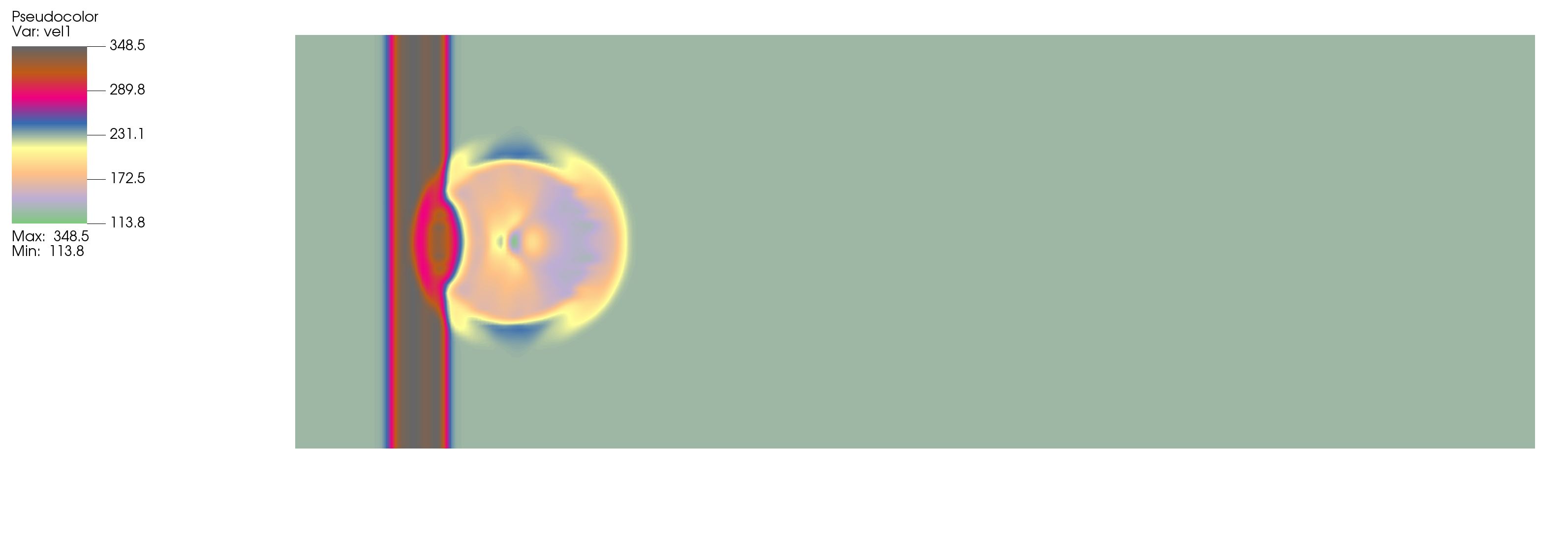
Early Stage (t = 0.1 ms)
The planar shock wave (Mach ~1.22) approaches the cylindrical helium bubble from the left. The undisturbed bubble maintains its circular shape, about to experience the initial shock impact. The velocity field shows the uniform shock propagation through the ambient air before interaction begins.
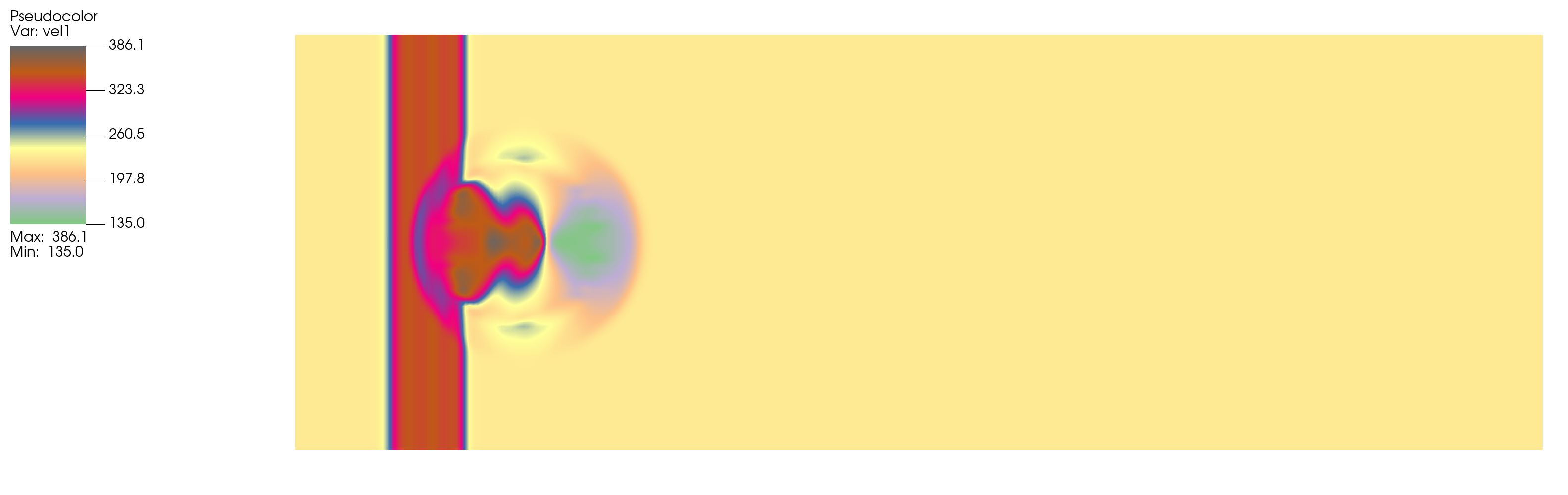
Compression & Deformation (t = 0.24 ms)
The shock has impacted the bubble interface. Due to the acoustic impedance mismatch (helium is lighter than air), the transmitted shock inside the bubble moves faster than the incident shock. The bubble begins to compress and deform, with the upstream interface flattening. A refracted shock propagates into the bubble while a reflected expansion wave moves back into the air.
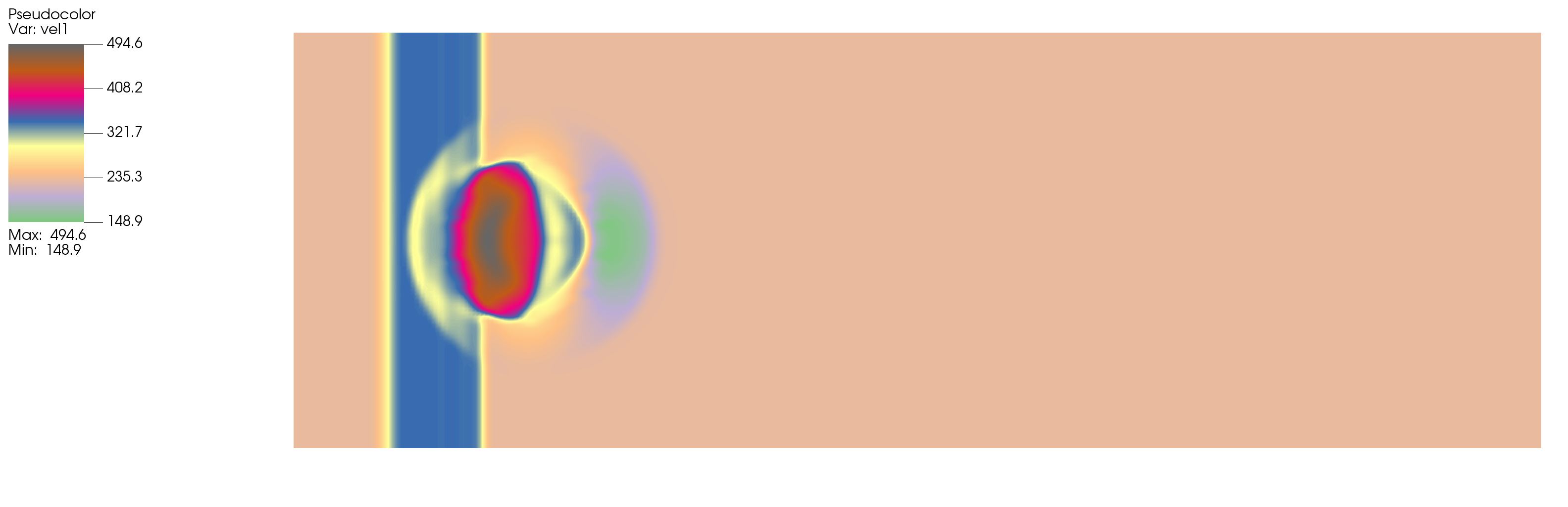
Instability Development (t = 0.32 ms)
Flow instabilities develop at the interface between the two gases. The Richtmyer-Meshkov instability manifests as interfacial perturbations grow due to impulsive acceleration from the shock. The bubble has deformed into a kidney-like shape. Vorticity is generated at the interface through baroclinic production (misalignment of pressure and density gradients).
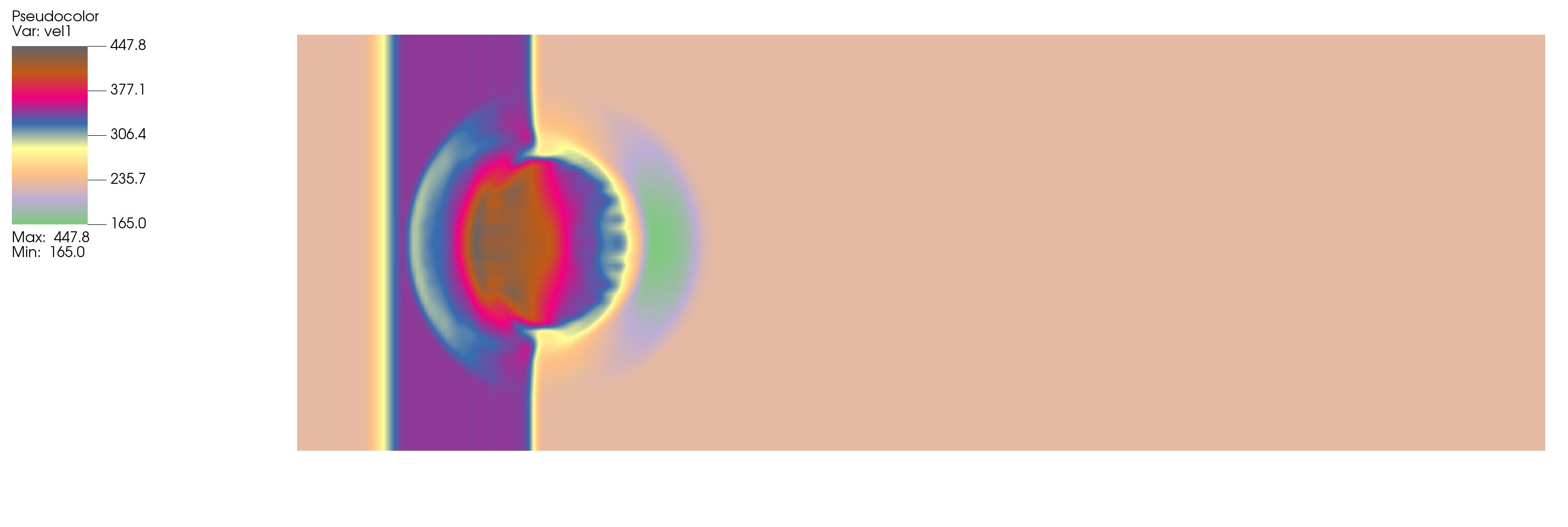
Vortex Formation & Mixing (t = 0.49 ms)
A counter-rotating vortex pair forms at the bubble interface, rolling up the helium into complex structures. The upstream portion of the bubble has developed a jet-like protrusion, while the downstream side exhibits mushroom-shaped features. Intense mixing occurs at the interface as helium and air intertwine. The shock continues propagating downstream, having deposited vorticity and energy into the bubble.
The Richtmyer-Meshkov Instability
The Richtmyer-Meshkov (RM) instability occurs when a shock wave passes through a perturbed interface between fluids of different densities. Named after Robert Richtmyer (1960) and Evgeny Meshkov (1969), this instability is fundamental to:
Inertial Confinement Fusion (ICF)
RM instabilities at the fuel capsule interface can prevent successful fusion ignition, making their prediction critical for ICF facility design.
Supernova Explosions
Astrophysicists study RM instabilities to understand mixing in supernova remnants and star formation processes.
Scramjet Combustion
Enhanced mixing from RM instabilities improves fuel-air mixing in supersonic combustion ramjets.
Why This Test Case Matters
The shock-bubble problem is a canonical benchmark for validating compressible multiphase solvers. It tests the code's ability to: (1) capture sharp discontinuities (shocks), (2) maintain interface sharpness between fluids, (3) correctly predict wave speeds in different materials, and (4) resolve complex flow features like vortices and mixing layers. NumericalAI's results match published experimental and computational data from leading research groups.
Simulation Configuration
Domain & Grid
Formulation:
2D Cartesian
Domain Size:
450 mm × 89 mm
Grid Resolution:
890 × 178
Total Cells:
158,420
Bubble Diameter:
50 mm
Fluid Properties
Ambient (Air):
ρ = 1.225 kg/m³, γ = 1.4
Bubble (Helium):
ρ = 0.166 kg/m³, γ = 1.648
Density Ratio:
~7.4:1 (air:helium)
Atwood Number:
A ≈ 0.76
Shock Conditions
Shock Mach:
M = 1.22
Shock Velocity:
~419 m/s
Pressure Jump:
~1.6×
Initial Position:
x = 150 mm
Numerical Methods
Spatial Scheme:
WENO5
Time Integration:
RK3-TVD
Riemann Solver:
HLLC
Interface Capture:
5-equation model
Computational Performance
~11 secs
Wall-Clock Time
A100
NVIDIA GPU
~700 MB
Memory Usage
~11×
Speedup vs CPU
Key Physics Phenomena
Acoustic Impedance Mismatch
The key to understanding shock-bubble interaction is acoustic impedance (Z = ρc, where ρ is density and c is sound speed):
Air: Z_air ≈ 428 Pa·s/m
Higher impedance due to greater density
Helium: Z_He ≈ 164 Pa·s/m
Lower impedance despite higher sound speed
When the shock encounters the low-impedance helium, part of the shock transmits (moving faster in helium due to higher sound speed) while part reflects as an expansion wave back into the air. This reflection reverses flow direction locally, initiating the bubble's inward collapse.
Baroclinic Vorticity Generation
The vorticity equation includes a baroclinic production term:
When pressure and density gradients are not aligned (as at the curved shock-bubble interface), vorticity is generated. This deposited vorticity rolls up into the counter-rotating vortex pair visible in the late-time images, driving mixing and turbulent transition.
Industrial Applications
Energy & Power Systems
Gas mixing optimization, detonation wave analysis, and combustion chamber design. Understanding shock-induced mixing improves fuel injection strategies and reduces emissions in gas turbines and engines.
Aerospace & Defense
Shockwave–fuel interactions in scramjets, blast-wave propagation for protective structure design, and inert gas mixing studies. Critical for hypersonic vehicle development and explosion safety analysis.
Research & Development
Flow visualization for high-speed impact studies, validation of multiphase CFD codes, and fundamental instability research. Essential for advancing our understanding of shock physics and multimaterial flows.
Process & Manufacturing
Shock wave lithotripsy modeling, ultrasonic cleaning optimization, and explosive forming process design. Predict material response and mixing efficiency in shock-driven industrial processes.
Why NumericalAI for Shock-Driven Multiphase Flows
Real-world physics, virtually recreated — Visualize shockwaves, vortices, and flow patterns in detail impossible to capture experimentally
High performance, scalable simulations — Designed for both desktop and HPC environments with GPU acceleration
Faster insights, smarter design — Reduce testing time and accelerate innovation safely through virtual prototyping
Validated compressible multiphase solver — Results match experimental shadowgraphs and published benchmarks from leading research institutions
Business Value & ROI
Traditional shock tube experiments cost thousands of dollars per test and provide limited data (single-point pressure measurements or schlieren images). NumericalAI delivers full-field data — pressure, velocity, density, temperature, and vorticity — everywhere in the domain, at every time step.
Cost Reduction: Replace dozens of expensive experiments with parametric simulation studies. Test multiple gas combinations, shock strengths, and geometries virtually before committing to hardware. Accelerate product development while reducing prototyping costs by 70%+.
Ready to Explore Shock-Driven Multiphase Flows?
Run your own shock-bubble simulations on NumericalAI's cloud platform. Visualize complex physics, validate designs, and accelerate innovation.
Scale-Resolving Simulation (SRS)
© 2026 SRS, a NumericalAI product by Empirisch Tech GmbH (empirischtech.at). All rights reserved. |Privacy Policy |Terms of Service |Executive brief |FAQ