
SRS
Scale-Resolving Simulation at Scale
Supersonic Wedge Flow Simulation
High-Fidelity Flow Simulation Around Complex Geometries
Experience cutting-edge computational fluid dynamics (CFD) powered by NumericalAI, a high-performance simulation framework for industrial-scale flow physics around complex geometries.
The example below showcases pressure and velocity distributions around a wedge geometry at supersonic conditions (Mach ≈ 1.5) using MFC with immersed boundary methods (IBM) and WENO-based compressible solvers. This simulation demonstrates NumericalAI's capability to handle shock-dominated flows around arbitrary STL geometries without complex grid generation.
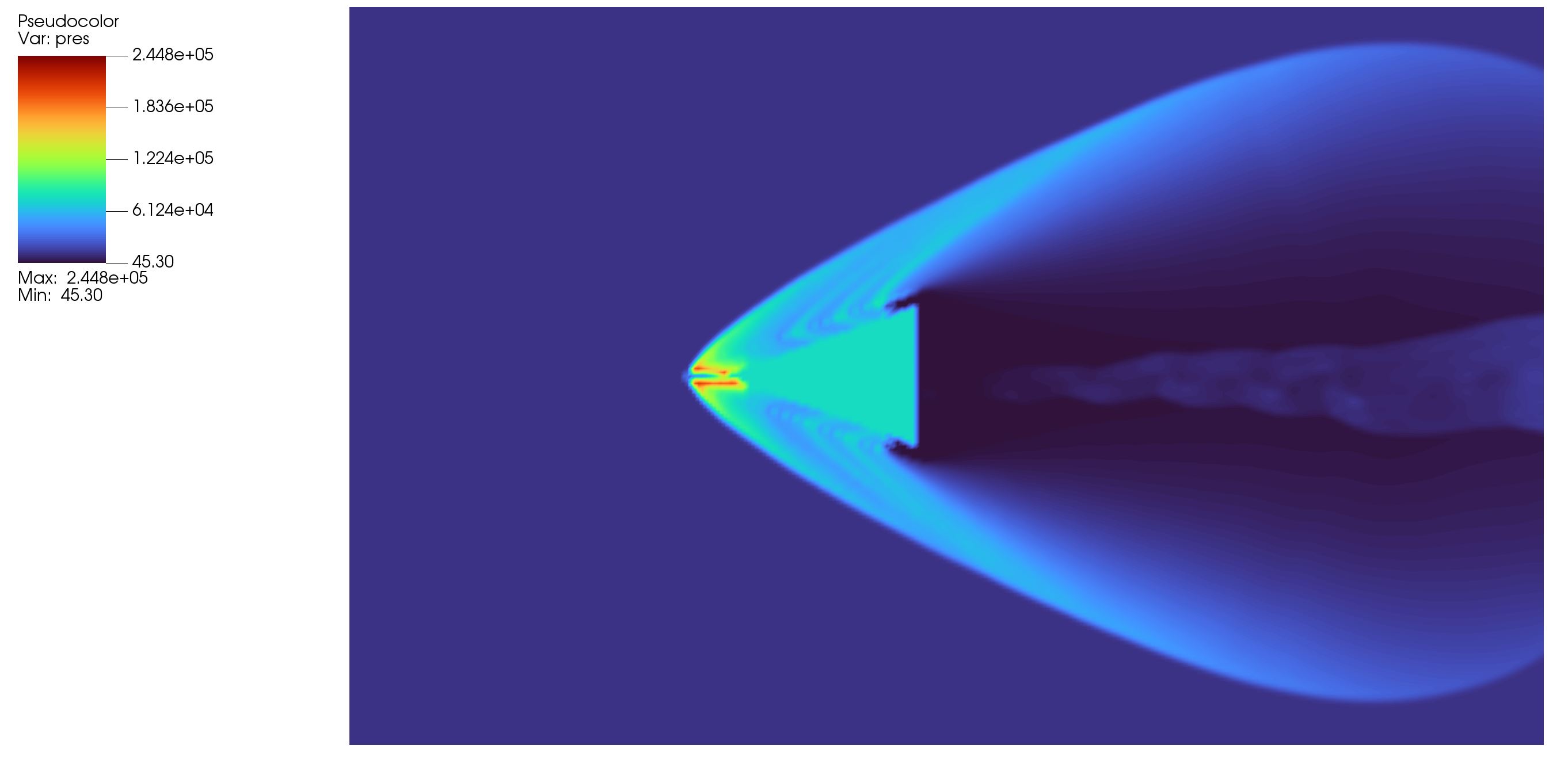
Pressure Distribution
Pressure distribution showing strong bow shock formation ahead of the wedge leading edge and downstream wake region. The oblique shock wave creates a sharp pressure jump across the shock front, with peak pressure at the stagnation point. The immersed boundary method captures the wedge geometry without body-fitted grids, while maintaining sharp shock resolution.
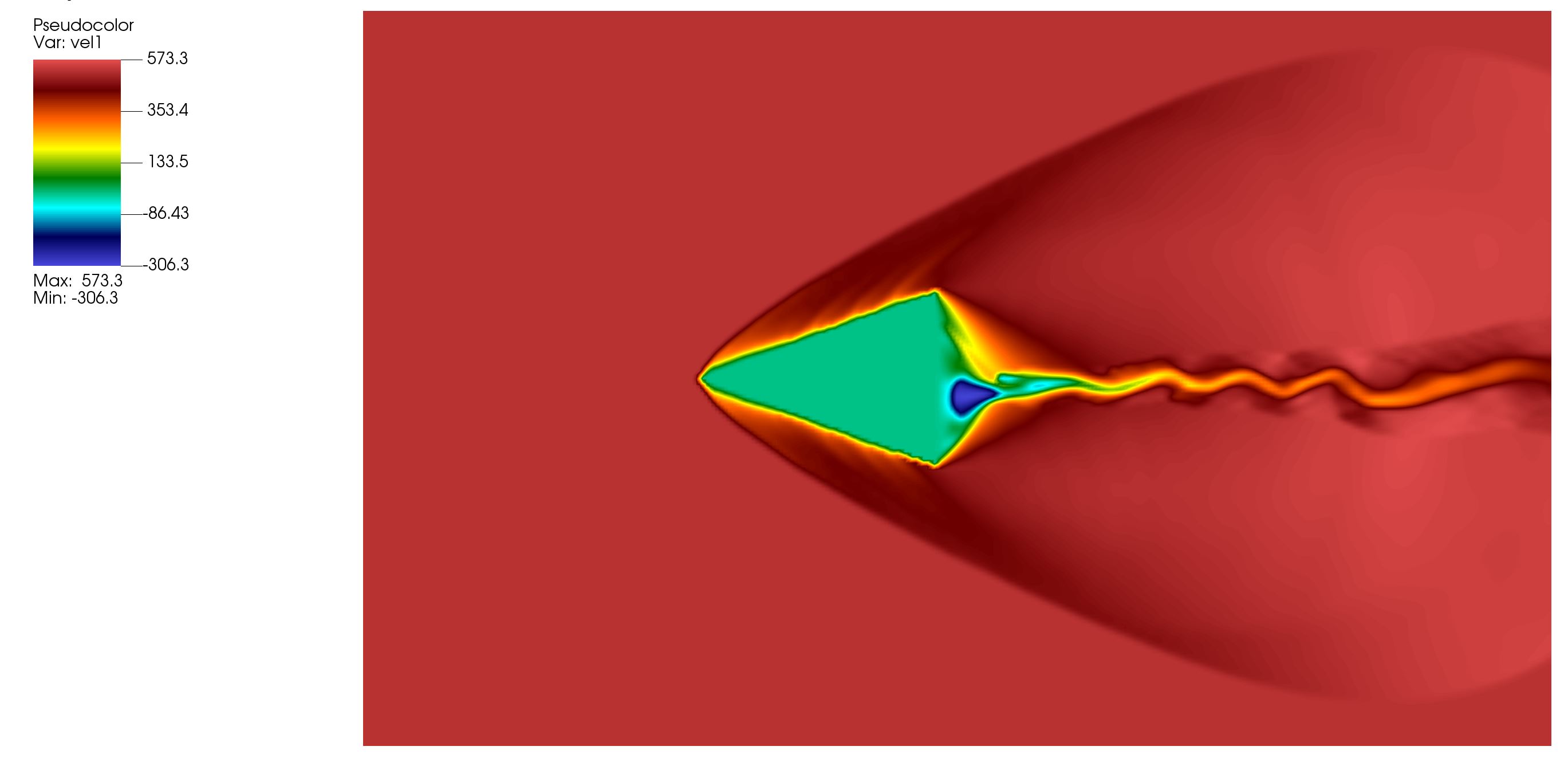
Velocity Magnitude Distribution
Velocity field highlighting shock reflections and shear-layer instabilities. The flow decelerates across the bow shock, then accelerates along the wedge surface. Complex shock-boundary layer interactions create vortical structures in the wake, critical for accurate drag and heat transfer predictions.
Simulation Configuration
Geometry & Grid
Formulation:
2D Cartesian + IBM
Grid Resolution:
399 × 199
Total Cells:
79,401
Geometry Input:
STL Surface
Wedge Angle:
15°
Flow Conditions
Mach Number:
M ≈ 1.5
Reynolds Number:
7.5 × 10⁶
Flow Regime:
Supersonic
Fluid:
Air (ideal gas)
Shock Angle:
~28° (oblique)
Numerical Methods
Spatial Scheme:
WENO5
Time Integration:
RK3-TVD
Riemann Solver:
HLLC
IBM Method:
Ghost-cell
CFL Number:
0.3
Boundary Conditions
Inlet (left):
Supersonic inflow (M = 1.5)
Outlet (right):
Non-reflecting outflow
Top/Bottom:
Slip walls
Wedge Surface:
No-slip wall (IBM)
Computational Performance
~1 min
Wall-Clock Time
A100
NVIDIA GPU
~1 GB
Memory Usage
~14×
Speedup vs CPU
Immersed Boundary Method (IBM)
What is IBM and Why It Matters
The Immersed Boundary Method is a powerful technique that allows simulation of flow around complex geometries without generating body-fitted grids. Instead of conforming the computational mesh to the geometry, IBM:
Uses Cartesian Background Grids
Simple, structured meshes with optimal cache performance and straightforward parallelization — no complex mesh generation required.
Accepts STL Geometry Directly
Import CAD models (STL format) without manual grid generation. Change geometry? Just swap the STL file — no re-meshing.
Enforces Boundary Conditions via Ghost Cells
The wedge surface cuts through the Cartesian grid. Ghost cells inside the solid enforce no-slip conditions through extrapolation, maintaining shock-capturing accuracy.
Industrial Workflow Benefits
For industrial users, IBM dramatically reduces simulation turnaround time. Traditional body-fitted meshing can take days for complex geometries and requires expert knowledge. With IBM on NumericalAI, you upload an STL, set flow conditions, and run — all within hours instead of weeks. Perfect for design optimization where dozens of geometry variations must be tested.
Supersonic Flow Physics
Oblique Shock Formation
When supersonic flow (M = 1.5) encounters the wedge, an oblique shock wave forms at an angle of approximately 28° to the freestream. Key physics:
Pressure Jump
Pressure increases by a factor of ~2.5 across the shock, creating high loads on the wedge surface. Critical for structural design.
Temperature Rise
Flow temperature increases across the shock due to compression, creating thermal loads that must be managed in aerospace applications.
Flow Deflection
Flow turns 15° to align with the wedge surface. The shock angle and deflection angle are related by the θ-β-M relation.
Entropy Generation
Shock waves are irreversible processes that generate entropy, representing a loss mechanism in propulsion systems.
Shock-Boundary Layer Interaction
At Re = 7.5×10⁶, the boundary layer along the wedge surface is thin but highly influential. The shock impingement creates an adverse pressure gradient that can cause flow separation in the near-wall region. This phenomenon is critical for:
- Supersonic inlet design (preventing flow separation)
- Drag prediction (separation increases form drag)
- Heat transfer analysis (peaks occur at reattachment points)
Industrial Applications
Aerospace Engineering
Shock–boundary layer interaction studies for supersonic inlet design, wing-body junctions, and control surface effectiveness. Essential for designing efficient supersonic aircraft and reducing wave drag.
Automotive Aerodynamics
External aerodynamics around sharp-edged structures like spoilers, diffusers, and A-pillars. Predict flow separation, vortex formation, and pressure distribution for drag reduction and downforce optimization.
Energy & Turbomachinery
Flow optimization around turbine blades, nozzles, and diffusers. Shock interactions affect efficiency, noise, and structural loading in compressors and turbines operating at transonic and supersonic conditions.
Defense & Propulsion
Missile fin analysis, ramjet/scramjet inlet design, and nozzle flow characterization. Accurate shock prediction is critical for performance, stability, and control authority at high speeds.
Why NumericalAI for Complex Geometry CFD
Robust, scalable parallel performance — HPC-ready for large-scale industrial computations with double-precision output
Accurate multiphase and compressible flow modeling — WENO5 shock-capturing with Riemann solvers for supersonic regimes
Seamless integration with STL-based CAD geometries — IBM eliminates weeks of manual meshing work
Fully customizable simulation workflows — Python-based configuration for automated parametric studies
Business Value & ROI
NumericalAI democratizes supersonic CFD — what used to require specialized grid generation expertise and dedicated HPC infrastructure is now accessible through an intuitive cloud interface.
Time Savings: Skip weeks of mesh generation. Upload STL, run simulation, get results — all in under an hour. Perfect for rapid design iterations where dozens of geometries must be evaluated.
Ready to Simulate Your Complex Geometries?
Experience the power of IBM-enabled CFD on NumericalAI. Upload your STL files, run supersonic simulations, and accelerate your design process.
Scale-Resolving Simulation (SRS)
© 2026 SRS, a NumericalAI product by Empirisch Tech GmbH (empirischtech.at). All rights reserved. |Privacy Policy |Terms of Service |Executive brief |FAQ