
SRS
Scale-Resolving Simulation at Scale
Learning Fluid Simulation with PyFR
A novice-friendly, beginner-to-advanced roadmap across aerospace, automotive, propulsion, wind, civil, and industrial flow simulation.
Prepared for NumericalAI / PyFR onboarding · Edition: July 2026
Table of Contents
How to Use This Guide
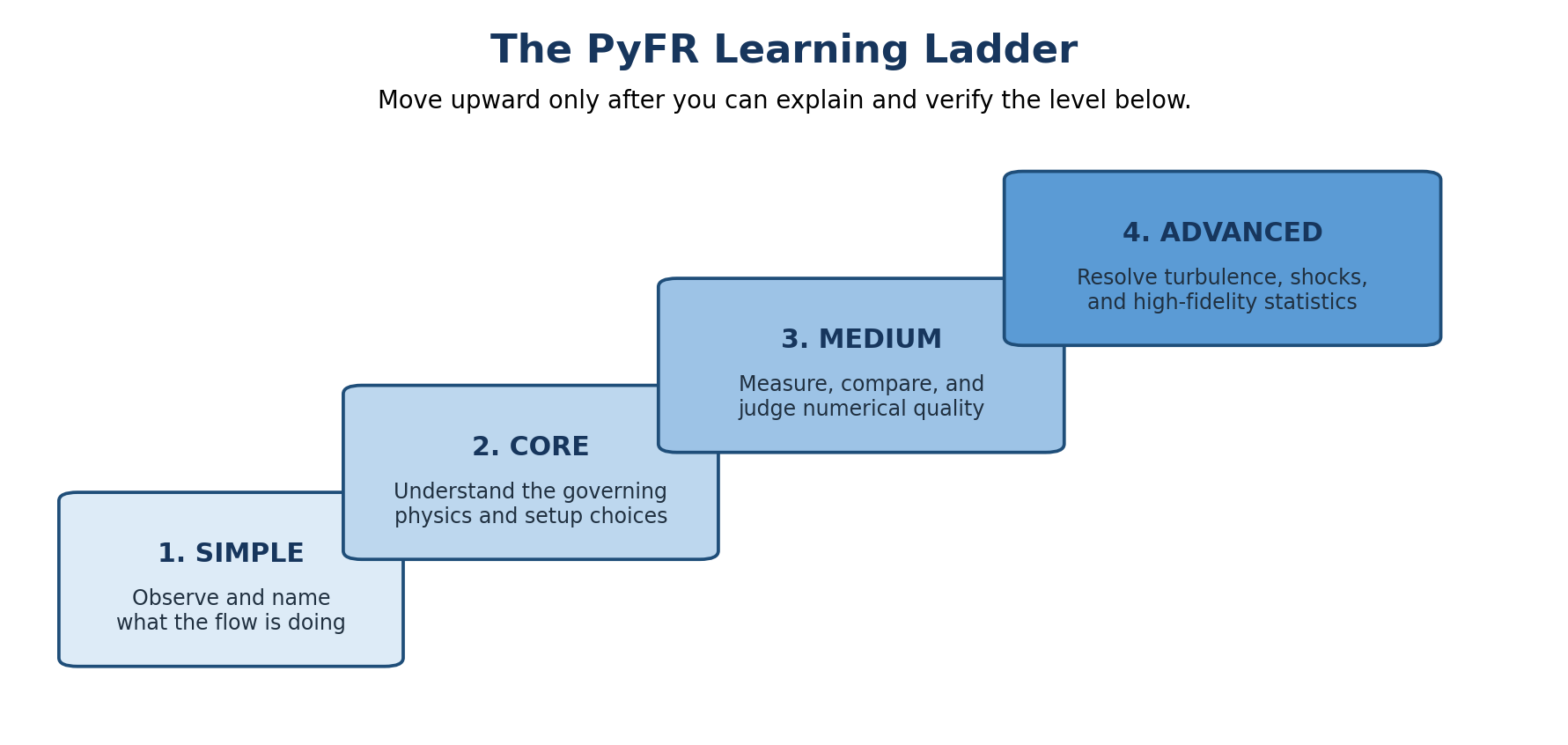
The sequence used throughout the document is:
- Simple: recognize the physical situation and the main quantities.
- Core: understand the governing physics, boundaries, mesh, and time dependence.
- Medium: interpret nondimensional parameters, forces, unsteadiness, and numerical sensitivity.
- Advanced: undertake high-order, scale-resolving, shock-containing, statistically converged, or large parallel simulations.
1. What PyFR Is — and What It Is Not
PyFR is an open-source CFD solver that uses a high-order Flux Reconstruction method on unstructured meshes. Its present documented governing systems are compressible Euler, compressible Navier–Stokes, artificial-compressibility Euler, and artificial-compressibility Navier–Stokes. These cover inviscid and viscous gas or liquid flow, including unsteady and turbulent flow problems.
1.2 Why PyFR is distinctive
High-order accuracy: each mesh element can represent a curved and smoothly varying solution with a polynomial rather than a single cell-average value.
Scale-resolving focus: it is particularly suited to unsteady turbulent structures, wakes, vortices, and flow features for which excessive numerical dissipation is undesirable.
Unstructured mixed-element meshes: useful for complex engineering geometries.
Cross-platform execution: current documentation describes CPU and multiple accelerator backends, including CUDA, HIP, OpenCL, Metal, and OpenMP.
Parallel operation: meshes can be partitioned and cases can run across multiple processes/devices.
1.3 What is directly in scope
| Simulation family | Typical examples | Relevant PyFR system |
|---|---|---|
| Low-speed viscous flow | Cylinder wakes, ducts, building wind, vehicle wakes | ac-navier-stokes |
| Low-speed inviscid idealization | Potential-like benchmark flows where wall shear is ignored | ac-euler |
| Compressible inviscid flow | Vortices, expansion waves, idealized shock problems | euler |
| Compressible viscous flow | High-speed boundary layers, jets, shock–boundary-layer interaction | navier-stokes |
| Unsteady force prediction | Lift, drag, side force, moment, vortex shedding | Fluid-force plugin plus a flow system |
| Far-field noise approximation | Noise estimated from an enclosing surface | Ffowcs Williams–Hawkings plugin |
1.4 Areas that require caution or another solver
PyFR is primarily a fluid-flow solver. The following are not standard out-of-the-box workflows in the current user documentation and should not be promised as ordinary PyFR capabilities without a specific extension, coupling strategy, or development effort:
Structural stress, deformation, fatigue, or crash mechanics.
Electromagnetics, RF, antennas, quantum-device fields, or circuit simulation.
Full conjugate heat transfer through both fluids and solid structures.
Multiphase free surfaces, droplets, cavitation, or particle-laden flow as standard models.
Detailed combustion chemistry and reacting species transport as a standard model.
Complete meteorology with atmospheric stratification, humidity, radiation, and weather physics.
True moving/sliding meshes for complete rotor–stator or multi-rotor motion unless a verified PyFR-specific method or extension is available.
2. Universal Foundations for Every CFD Field
2.1 Simple concepts: learn to describe the flow
| Concept | Plain-language meaning | What to look for in a result |
|---|---|---|
| Fluid domain | The space occupied by air, water, or another fluid. | Is the simulated region large enough and connected correctly? |
| Velocity | Speed and direction of the fluid. | Fast regions, slow regions, recirculation, and direction changes. |
| Pressure | Normal force per unit area exerted by the fluid. | High-pressure stagnation zones and low-pressure suction zones. |
| Density | Mass per unit volume. | Nearly constant in low-speed flows; strongly variable in compressible flows. |
| Viscosity | Resistance to shearing motion. | Wall friction, boundary layers, diffusion of velocity gradients. |
| Steady flow | The statistical or exact solution does not change with time. | A fixed field or stable mean. |
| Unsteady flow | The flow changes with time. | Oscillating forces, moving vortices, waves, and transient events. |
| External flow | Fluid moves around an object. | Wings, cars, buildings, cylinders, blades. |
| Internal flow | Fluid moves through a passage. | Ducts, pipes, nozzles, fans, valves, heat-exchanger passages. |
2.2 Core concepts: understand why the flow behaves that way
Conservation of mass: fluid mass cannot appear or disappear inside the domain unless a source is deliberately introduced.
Conservation of momentum: pressure, viscosity, and body forces change the fluid’s motion.
Conservation of energy: important for compressible flows where temperature, pressure, density, and speed are coupled.
Inviscid versus viscous: Euler equations omit viscous stresses; Navier–Stokes equations include them.
Compressible versus incompressible: density variations are retained in compressible modelling and suppressed through an incompressible formulation when appropriate.
Initial conditions: the flow state at simulation start.
Boundary conditions: rules applied at inlets, outlets, walls, far-field boundaries, symmetry planes, and periodic pairs.
Mesh: the geometric partition on which the solution is represented.
Time step: the increment through which an unsteady solution advances.
2.3 Medium concepts: learn the organizing parameters
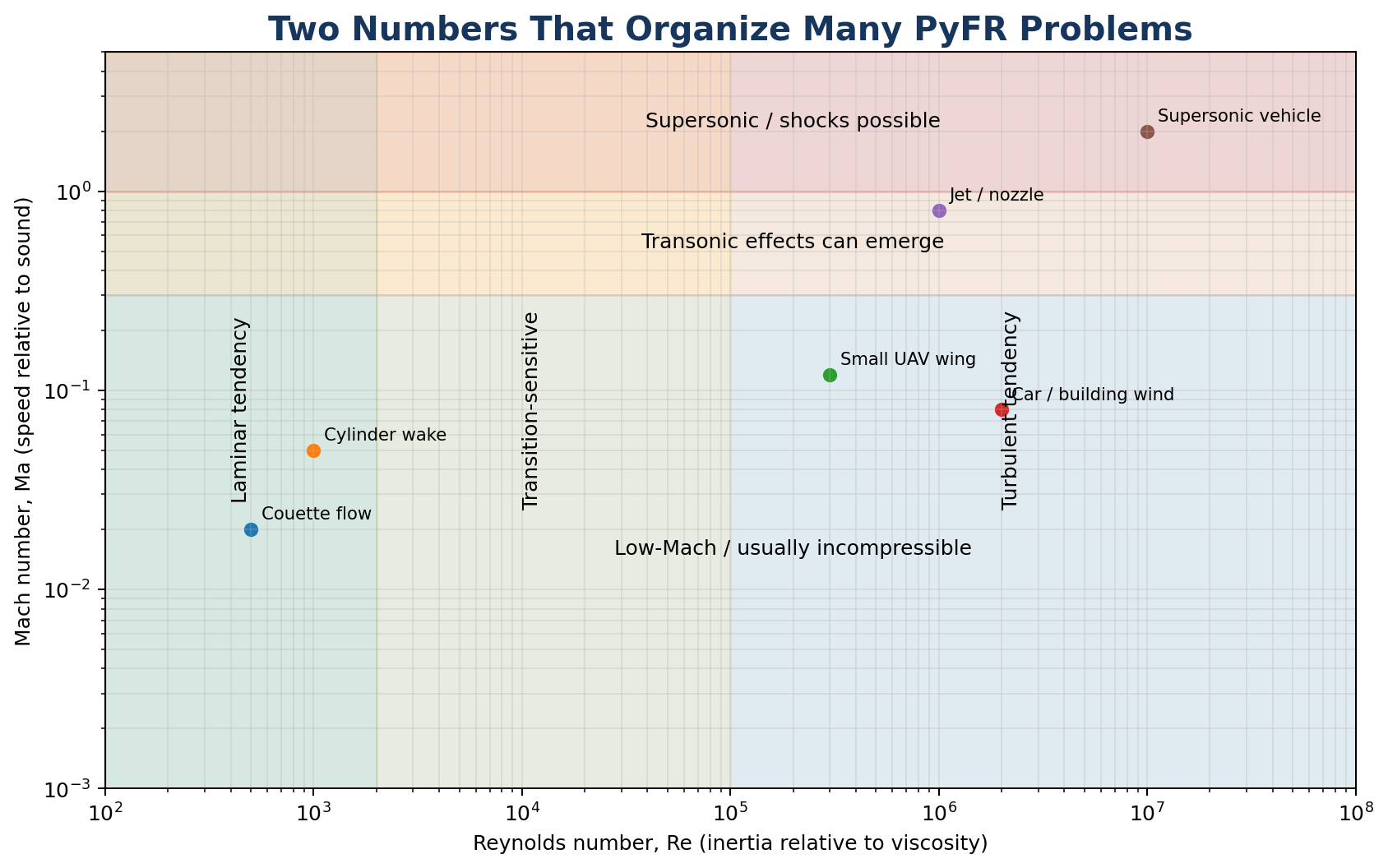
A small set of nondimensional numbers organizes a large fraction of engineering CFD:
Reynolds number, Re = ρUL/μ: compares inertial effects with viscous effects. Higher values usually produce thinner boundary layers, stronger separation sensitivity, and more turbulent scales.
Mach number, Ma = U/a: compares flow speed with the speed of sound. It indicates when compressibility, wave propagation, and shocks may matter.
Strouhal number, St = fL/U: describes the nondimensional frequency of periodic unsteadiness such as vortex shedding.
Pressure coefficient, Cp: presents surface pressure in a normalized form useful for comparing geometries and speeds.
Lift and drag coefficients, CL and CD: normalize aerodynamic forces so designs can be compared.
2.4 Advanced concepts: understand high-fidelity simulation
Spatial order (p-order): the polynomial order used inside each element. Raising order can increase accuracy without changing the element count, but increases cost and may expose mesh-quality problems.
Flux Reconstruction: a high-order discretization framework that reconstructs fluxes and corrects them to communicate consistently across element interfaces.
Direct Numerical Simulation (DNS): resolves all dynamically relevant turbulence scales; extremely expensive at engineering Reynolds numbers.
Large-Eddy Simulation (LES) and implicit LES: resolve large turbulent structures while modelling or numerically dissipating smaller scales.
Aliasing: errors caused by nonlinear terms being under-integrated. Anti-aliasing and adequate quadrature can improve robustness and accuracy.
Shock capturing: stabilization for discontinuities; current PyFR options include entropy filtering and artificial viscosity for relevant compressible systems.
Statistical convergence: mean values and spectra are meaningful only after transients have passed and sufficient independent flow events have been sampled.
Scalability: how efficiently a case uses more GPUs/CPUs; partition balance, communication, and element mix matter.
3. Selecting the PyFR Governing System
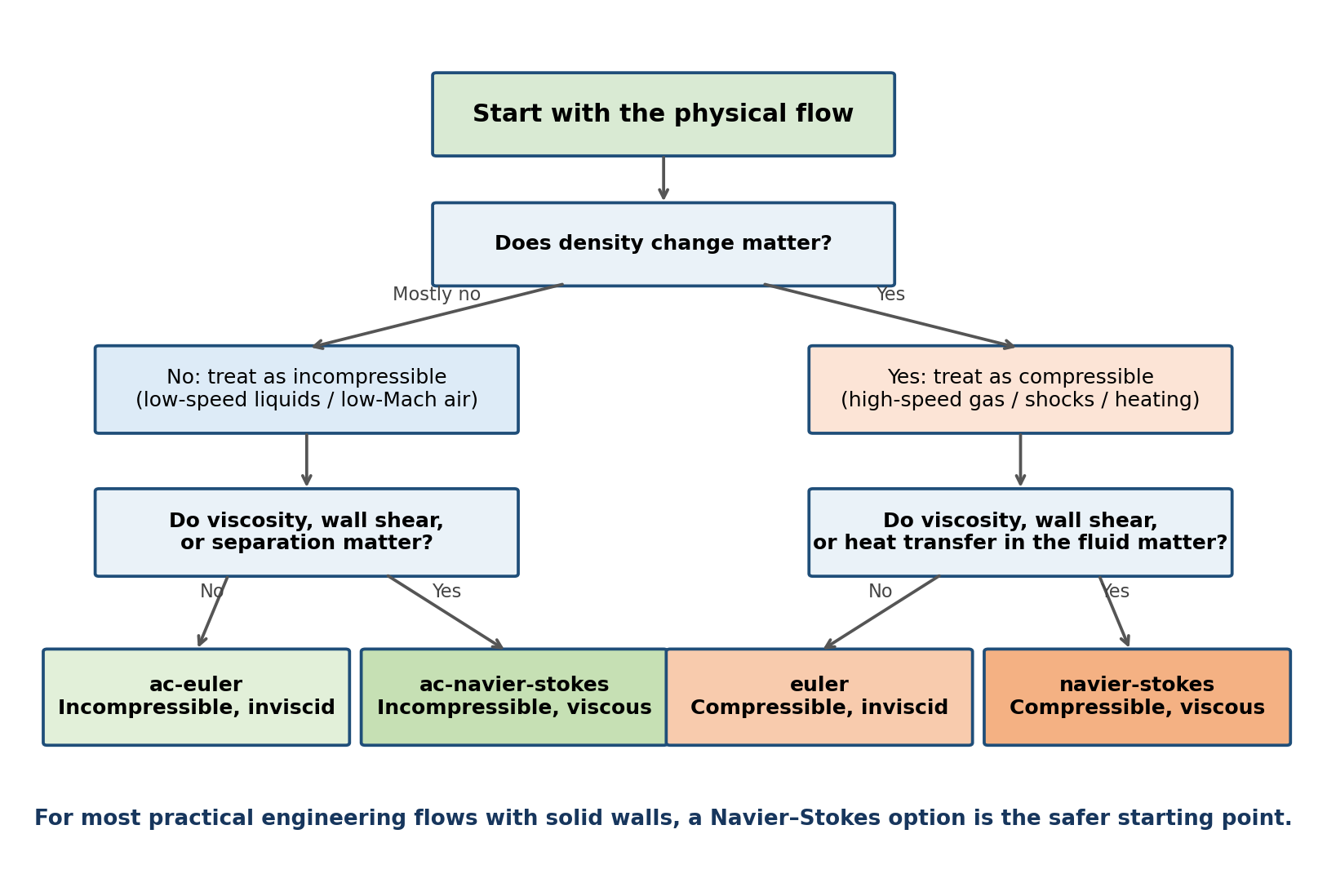
3.1 The four documented system choices
| System | Physical interpretation | Good novice use | Main limitation |
|---|---|---|---|
ac-euler | Incompressible and inviscid | Educational idealizations of low-speed flow | No viscous wall shear or boundary layer |
ac-navier-stokes | Incompressible and viscous | Cylinder, duct, vehicle, building, fan-duct, low-speed aero | Does not model compressible acoustic waves as physical pressure waves |
euler | Compressible and inviscid | Euler vortex, wave and shock benchmarks, preliminary high-speed flow | No viscous boundary layer, heating, or skin friction |
navier-stokes | Compressible and viscous | High-speed aerodynamics, jets, shock/boundary-layer flow | More variables and potentially stricter resolution requirements |
3.2 A minimum setup vocabulary
| Setup item | Beginner question | Typical failure if misunderstood |
|---|---|---|
| Geometry/domain | What part is solid and what part is fluid? | Simulating the solid instead of the surrounding fluid, or leaving gaps. |
| Inlet/far field | What flow enters and from which direction? | Wrong angle of attack, speed, turbulence, density, or pressure. |
| Outlet | What information is allowed to leave? | Reflection, instability, or artificial pressure gradients. |
| Wall | Slip, no-slip, adiabatic, or isothermal? | Missing drag, wrong thermal response, or unphysical penetration. |
| Initial field | How close is the initial state to the expected solution? | Long transients or solver failure. |
| Order | How much variation is represented inside each element? | Too dissipative at low order or unstable/costly at high order. |
| Time step | How far does the solution advance each step? | Instability, lost temporal accuracy, or excessive cost. |
| Output sampling | How often are fields and statistics stored? | Huge files or insufficient temporal resolution. |
4. External Aerodynamics: Aerospace, UAV, Defense, Automotive, and Motorsport
External aerodynamics asks how air moves around a body and how the pressure and viscous stresses produce forces, moments, separation, wakes, and noise.
| Level | Concepts to learn | Questions / practice cases | Outputs to understand |
|---|---|---|---|
| Simple | Airfoil/wing/body vocabulary; angle of attack; stagnation; suction; wake; lift and drag. | Visualize flow around a 2D airfoil or simplified vehicle section. Predict where high and low pressure should occur. | Velocity and pressure contours; streamlines; qualitative wake shape. |
| Core | Boundary layer; no-slip wall; pressure drag versus skin-friction drag; separation; finite domain and far-field boundaries. | Run an incompressible cylinder and then a low-speed airfoil. Compare inviscid and viscous expectations. | Surface pressure; force history; CL/CD; separation location. |
| Medium | Reynolds/Mach number; transition sensitivity; vortex shedding; stall; 3D tip vortices; ground effect; yaw/crosswind. | NACA wing section, simplified drone fuselage, Ahmed-body-like vehicle, or rear-wing element. | Time-averaged forces; Cp distribution; wake deficit; Strouhal number. |
| Advanced | High-order wall resolution; inflow turbulence; implicit LES/LES concepts; aeroelastic forcing; dynamic stability; spectral analysis. | 3D wing/fuselage or re-entry-capsule wake with long-time statistics and force/moment spectra. | Turbulence statistics; spectra; coherent structures; uncertainty and convergence. |
Representative use cases
Fixed-wing UAV wing sections and control surfaces
Drone fuselage, motor pod, strut, landing gear, or sensor housing
Automotive body, spoiler, diffuser, mirror, wheel-adjacent flow, and crosswind
Missile, projectile, or re-entry-body aerodynamics on fixed geometry
5. Internal Flows and Industrial Equipment
Internal-flow simulation predicts pressure loss, flow uniformity, recirculation, mixing, pulsation, and wall loading inside ducts, channels, manifolds, nozzles, valves, and equipment passages.
| Level | Concepts to learn | Questions / practice cases | Outputs to understand |
|---|---|---|---|
| Simple | Inlet, outlet, wall, cross-section, flow rate, pressure drop, and recirculation. | Straight channel or Couette flow; inspect how velocity varies between walls. | Velocity profile; pressure variation; mass-flow consistency. |
| Core | No-slip wall; developing flow; entrance length; laminar versus turbulent; contraction and expansion losses. | Duct bend, sudden expansion, converging nozzle, or manifold branch. | Pressure drop; flow split; wall shear; recirculation zones. |
| Medium | Secondary flow; swirl; jets in crossflow; pulsatile flow; mixing quality; loss coefficient; residence-time thinking. | Fan duct, valve-like restriction, multi-outlet manifold, or cooling passage. | Total/static pressure; uniformity index; turbulence intensity; frequency response. |
| Advanced | Scale-resolving separated internal flow; compressible choking; shock trains; complex mixed-element curved meshes; coupled source terms. | High-speed nozzle/duct, ejector-like fixed geometry, or high-Re separated industrial passage. | Spectra; loss budgets; shock motion; statistically averaged non-uniformity. |
Representative use cases
Ventilation and process ducts
Pump/fan housings as fixed-flow passages
Valves, bends, diffusers, manifolds, mixers, and nozzles
Electronics or machinery airflow passages when solid heat conduction is treated separately
6. Turbomachinery, Propulsion, and Energy Flows
This field examines flow through blades, vanes, ducts, intakes, compressors, turbines, fans, propulsors, jets, and energy-conversion passages.
| Level | Concepts to learn | Questions / practice cases | Outputs to understand |
|---|---|---|---|
| Simple | Blade as an airfoil; pressure side/suction side; inlet, exit, turning, and wake. | Stationary cascade or blade section with prescribed inflow. | Pressure distribution; flow turning; wake thickness. |
| Core | Total pressure and temperature; mass flow; incidence; losses; choking; blade loading. | Fixed blade passage, intake, diffuser, or nozzle. | Mass flow; pressure ratio; loss coefficient; blade force. |
| Medium | Secondary flows; tip leakage concept; rotor/stator wakes; compressibility; shock–boundary-layer interaction; acoustic tones. | High-speed stationary blade row or ducted-fan passage using an appropriate fixed-domain approximation. | Entropy/loss fields; wake profiles; shock position; unsteady loading. |
| Advanced | Wall-resolved or wall-modelled scale-resolving simulation; multi-passage periodicity; synthetic turbulence; long-time phase/statistical analysis. | Research-grade blade passage, jet, or intake with high-order curved mesh and GPU scaling. | Turbulence spectra; loss mechanisms; coherent structures; acoustic source indicators. |
Representative use cases
Stationary blade cascades and passage aerodynamics
Nozzles, intakes, diffusers, exhausts, and jets
Ducted-fan or propulsor passages under fixed-geometry approximations
Turbulent blade wakes and high-speed shock-containing passages
7. Wind Energy, Environmental Wind, and Civil/Building Aerodynamics
These low-speed flows focus on wind loads, wakes, pedestrian-level wind, ventilation, pollutant transport approximations, terrain/obstacle effects, and wind-energy interactions.
| Level | Concepts to learn | Questions / practice cases | Outputs to understand |
|---|---|---|---|
| Simple | Wind direction, speed, obstacle, shelter region, wake, pressure on surfaces. | Flow around a 2D square/cylinder or simple building block. | Velocity contours; recirculation; surface pressure. |
| Core | Atmospheric-like inlet profile concept; no-slip ground; blockage; domain size; crosswind; force coefficients. | Single building, bridge-deck section, solar-panel row, or fixed wind-turbine support. | Mean wind speed; pressure coefficient; drag/lift; wake length. |
| Medium | Turbulence intensity/length scale; gusts; vortex shedding; interference between buildings; urban-canyon flow. | Building cluster, bridge cross-section, rooftop equipment, or fixed wind-turbine blade section. | Time-averaged/peak loads; spectra; comfort or ventilation proxies. |
| Advanced | Scale-resolving urban or terrain flow; synthetic inflow turbulence; long statistical windows; aeroacoustic or fatigue-relevant loading. | Complex building cluster or wind-farm component wake under selected neutral-flow assumptions. | Turbulence statistics; gust factors; load spectra; coherent wake structures. |
Representative use cases
Wind loading on buildings, roofs, panels, signs, and bridge sections
Pedestrian-level wind and ventilation-flow proxies
Wind-turbine blade sections, towers, nacelles, and fixed-geometry wake studies
Urban and industrial-site wind interaction
8. High-Speed, Shock-Dominated, and Re-entry-Type Flows
High-speed CFD deals with density and temperature changes, pressure waves, expansion fans, shock waves, and their interaction with boundary layers and wakes.
| Level | Concepts to learn | Questions / practice cases | Outputs to understand |
|---|---|---|---|
| Simple | Speed of sound, Mach number, compression, expansion, and shock as an abrupt change. | Euler vortex and double-Mach-reflection benchmark. | Density, pressure, Mach contours; wave position. |
| Core | Subsonic/supersonic inlet and outlet logic; total versus static quantities; inviscid versus viscous shock behaviour. | Nozzle, wedge, shock tube, or supersonic body. | Shock angle/location; pressure ratios; mass flow. |
| Medium | Shock capturing; artificial viscosity/entropy filtering; viscous heating; shock–boundary-layer interaction; separation. | Viscous shock tube or supersonic airfoil/body with controlled mesh refinement. | Wall pressure/heat-related fluid variables; shock motion; separation bubble. |
| Advanced | Shock/turbulence interaction; high-order stability; curved geometry; hypersonic/re-entry wake dynamics under verified gas assumptions. | Research-grade shock-containing turbulent flow or capsule wake. | Spectra, unsteady forces/moments, shock statistics, grid/order sensitivity. |
Representative use cases
Supersonic inlets, nozzles, jets, and shock tubes
High-speed airfoils, projectiles, missiles, and fixed re-entry shapes
Shock–boundary-layer and shock–turbulence interaction
Unsteady high-speed wakes and dynamic-stability studies
9. Unsteady Flow, Turbulent Wakes, and Aeroacoustics
Unsteadiness is often the reason to use PyFR: vortices, turbulence, periodic shedding, force fluctuations, and acoustic-source behaviour are poorly represented by a single steady picture.
| Level | Concepts to learn | Questions / practice cases | Outputs to understand |
|---|---|---|---|
| Simple | A vortex; a wake; periodic motion; time history; frequency. | Watch vortex shedding behind a cylinder. | Animation; force oscillation; dominant period. |
| Core | Transient startup; sampling rate; transient removal; Strouhal number; mean versus fluctuation. | Compute cylinder drag/lift histories and estimate shedding frequency. | Mean/rms values; FFT peak; phase relationship. |
| Medium | Turbulent energy cascade; coherent structures; autocorrelation; spectra; time averaging; synthetic inflow turbulence. | 3D wake, aerofoil with turbulent inflow, or Taylor–Green vortex. | Turbulence statistics; spectra; Q/vorticity structures; convergence of averages. |
| Advanced | LES/DNS resolution; acoustic analogies; FWH surface/observer choice; bandwidth; windowing; statistical uncertainty. | Aerofoil, bluff body, jet, or landing-gear-like fixed geometry with far-field noise approximation. | Sound pressure history/spectrum; source-region interpretation; uncertainty. |
Representative use cases
Vortex shedding and buffet-like force oscillations
Wake mixing and coherent structures
Turbulent inflow and wake interaction
Far-field aeroacoustic approximation using the FWH plugin
10. A Reliable End-to-End PyFR Workflow
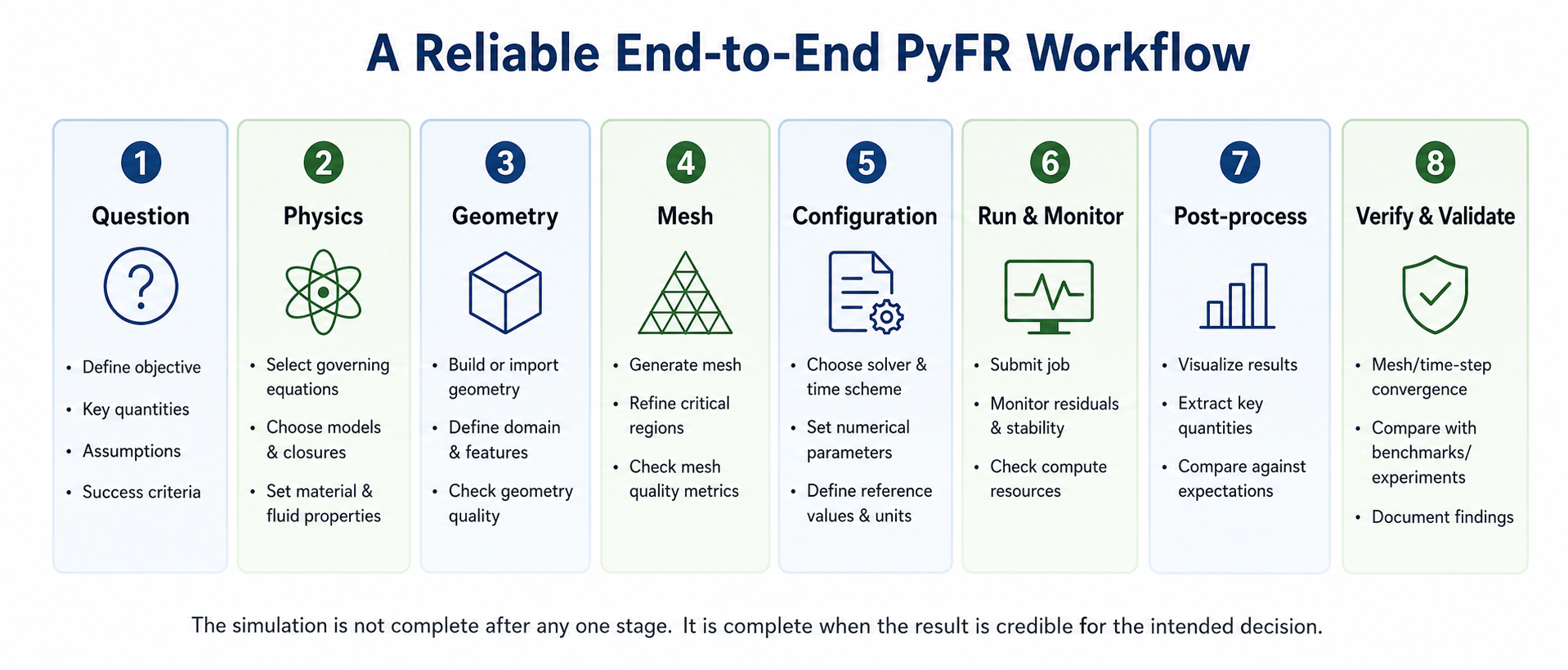
10.1 Start with the engineering decision
A useful simulation begins with a question that can be answered by measurable outputs. "Simulate a drone" is too vague. "Estimate the change in mean lift, drag, and pitching moment when angle of attack increases from 4° to 8° at a specified Reynolds and Mach number" is actionable.
10.2 Build a physics checklist
Fluid and property model: air, water, ideal gas, viscosity law.
Compressibility: does density change significantly or are waves/shocks important?
Viscosity: are wall shear, boundary layers, drag, separation, or mixing important?
Time dependence: is a mean solution enough, or are fluctuating loads/frequencies required?
Turbulence: laminar, transitional, turbulent, synthetic inflow, LES/implicit LES, or DNS intent?
Thermal assumptions: adiabatic or isothermal walls; is solid conduction absent?
Motion: fixed geometry, rotating reference approximation, or a capability that must be separately verified?
10.3 Geometry and domain simplification
Remove tiny details that do not affect the decision but force extremely small elements.
Retain edges, gaps, radii, and appendages that control separation, leakage, or wake formation.
Place far-field boundaries sufficiently far from external bodies.
Provide adequate upstream and downstream lengths for internal flows and wakes.
Use symmetry or periodicity only when the physics truly supports it.
10.4 Mesh thinking for a high-order solver
| Region | Why it needs attention | Typical refinement intent |
|---|---|---|
| Solid walls | Velocity gradients and shear form near walls. | Layered/curved resolution appropriate to the modelling objective. |
| Leading edges / noses | High curvature and strong acceleration. | Curved elements and locally smaller spacing. |
| Separation zones | Unsteady shear layers originate here. | Resolve geometry and the emerging shear layer. |
| Wakes | Forces, mixing, and noise depend on downstream vortices. | Maintain resolution downstream; avoid sudden coarsening. |
| Shocks | Discontinuous/steep gradients need stabilization and resolution. | Align/refine where practical and use suitable shock capturing. |
| Inlets | Turbulence and profile must enter without mesh artifacts. | Consistent spacing and sufficient injection region. |
| Mixed-element interfaces | Cost and partition balance can vary by element type. | Check quality, weights, and partition balance. |
10.5 The PyFR file and command mental model
| Item | Purpose | Typical operation |
|---|---|---|
.msh | Mesh produced by Gmsh or another compatible workflow. | Create and tag geometry boundaries. |
.pyfrm | Imported PyFR mesh, including partitionings. | pyfr import; pyfr partition add/list/info. |
.ini | Simulation configuration. | Choose system, order, integrator, boundaries, plugins, and output. |
.pyfrs | PyFR solution/restart/statistics data. | Run/restart and retain configuration metadata. |
.vtu/.pvtu | Visualization output. | pyfr export volume/boundary and inspect in ParaView. |
Current PyFR documentation presents import, partition, run, restart, region, and export commands, with parallel runs using a mesh partitioning matching the process/device count.
10.6 Monitor before trusting
Residual or update behaviour: is the solution stable and behaving consistently?
NaN checks and crash diagnostics: do not treat a completed write as proof of healthy physics.
Mass flow and conservation: does inlet/outlet balance make physical sense?
Force histories: have initial transients decayed and has a periodic/statistical regime formed?
Time-step statistics: is adaptive stepping behaving as intended?
Field inspection: are there nonphysical oscillations, boundary reflections, or mesh-imprinted patterns?
Hardware utilization and partition balance: is the problem large enough and balanced for the selected devices?
10.7 Post-processing outputs by decision type
| Decision | Primary outputs | Secondary checks |
|---|---|---|
| Reduce drag | Mean drag coefficient; pressure and viscous force split | Wake deficit, separation position, domain sensitivity |
| Increase lift | CL and Cp distribution | Moment, stall onset, 3D tip effects |
| Reduce pressure loss | Total-pressure loss / Δp / mass flow | Recirculation, flow uniformity, wall shear |
| Control vibration | Force/moment spectra and dominant frequency | Strouhal number, coherence, statistical duration |
| Reduce noise | Observer pressure/spectrum from FWH approximation | Surface placement, sample rate, flow/acoustic assumptions |
| Improve uniformity | Outlet profile and uniformity index | Mesh/order sensitivity and averaging window |
| Assess wind load | Mean, rms, and peaks of force/pressure | Inflow turbulence and duration uncertainty |
11. Progressive Practice Simulations
The official test cases provide a useful backbone. The order below is selected for learning, not for industrial importance.
| # | Case | Level | Main concepts | System |
|---|---|---|---|---|
| 1 | 2D Euler vortex | Simple → Core | Convection, density/velocity fields, periodicity, numerical accuracy | euler |
| 2 | 2D Couette flow | Simple → Core | Viscosity, no-slip wall, linear velocity profile, steady solution | navier-stokes |
| 3 | 2D incompressible cylinder | Core → Medium | Boundary layer, separation, vortex shedding, force history | ac-navier-stokes |
| 4 | 2D double Mach reflection | Core → Medium | Shock waves, reflections, discontinuities, shock capturing | euler |
| 5 | 2D viscous shock tube | Medium | Compressible viscosity, shocks, contact structures, wall interaction | navier-stokes |
| 6 | 3D Taylor–Green vortex | Medium → Advanced | Transition to turbulence, energy decay, 3D vortical structures | navier-stokes |
| 7 | 3D triangular aerofoil | Medium → Advanced | Complex geometry, inflow turbulence, 3D wake and statistics | navier-stokes |
| 8 | Custom NACA airfoil / cylinder crossflow | Medium | Engineering coefficients, mesh/domain study, comparison to references | ac-navier-stokes or navier-stokes |
| 9 | Custom duct/nozzle/building | Medium → Advanced | Field-specific workflow, geometry simplification, decision metrics | Choose from Section 3 |
| 10 | Research-scale 3D turbulent case | Advanced | High order, long averaging, spectra, scaling, validation | Problem dependent |
11.1 Learning task for every case
- Write one paragraph predicting the expected flow before running.
- List the governing system, major boundary conditions, Reynolds/Mach number, order, and time-step strategy.
- Identify one scalar metric and one field visualization that answer the case question.
- Inspect the solution for at least three nonphysical warning signs.
- Repeat one numerical choice — mesh, order, time step, domain, or averaging duration — and quantify the change.
- Write a conclusion that states both the result and its limitations.
12. Verification, Validation, and Common Failure Modes
12.1 Verification versus validation
Verification
Are the equations being solved accurately enough for the chosen numerical setup?
Validation
Do the equations and assumptions represent the real physical problem adequately?
12.2 Minimum credibility ladder
- Sanity check: directions, units, magnitudes, and qualitative flow pattern are plausible.
- Conservation check: mass and other relevant balances are acceptable.
- Temporal check: time step and sampling rate are adequate.
- Spatial check: mesh and polynomial-order refinement do not materially change the decision metric.
- Domain/boundary check: far-field, inlet, outlet, and periodic assumptions do not control the answer artificially.
- Statistical check: mean, rms, and spectra are based on enough post-transient data.
- Validation check: compare against an analytical solution, trusted benchmark, experiment, or independently verified solver.
12.3 Common novice mistakes
| Mistake | Why it is dangerous | Correction |
|---|---|---|
| Choosing Euler for a drag/separation problem | No viscous boundary layer or skin friction. | Use a Navier–Stokes system and adequate wall/wake resolution. |
| Using a steady interpretation for an unsteady wake | Mean values can hide large oscillatory loads. | Run sufficiently long and inspect force histories/spectra. |
| Increasing order on a poor mesh | High order does not repair invalid geometry or bad elements. | Improve mesh quality and curved representation first. |
| Domain too small | Boundaries alter pressure, blockage, and wakes. | Perform domain-size sensitivity. |
| Outlet too close | Reflections or back influence corrupt the solution. | Extend downstream domain and use suitable outlet conditions. |
| Saving too frequently | I/O dominates and storage explodes. | Separate restart, visualization, and sampling frequencies. |
| Saving too infrequently | Frequencies and transient events are missed. | Choose sampling from expected highest relevant frequency. |
| Reporting one run as truth | Numerical and modelling uncertainty are unknown. | Perform mesh/order/time/domain and assumption studies. |
| Confusing numerical pressure in artificial compressibility with acoustics | Incompressible formulation is not physical compressible wave propagation. | Use a compressible model or validated acoustic analogy as appropriate. |
| Ignoring startup transient | Statistics include initialization artifacts. | Define tstart after the flow reaches the desired regime. |
12.4 Useful PyFR output capabilities
Fluid-force integration for pressure and viscous force/moment histories.
Time averaging and standard-deviation statistics for primitive-variable expressions.
Synthetic-eddy turbulence injection for selected inflow-region use cases.
Ffowcs Williams–Hawkings far-field noise approximation at specified observer points.
Sampling, residual, integration, writer, NaN-check, and in-situ visualization plugins described in the user guide.
13. Twelve-Week Learning Plan
| Week | Theme | Concepts and activity | Deliverable |
|---|---|---|---|
| 1 | Fluid intuition | Velocity, pressure, viscosity, density, steady/unsteady; use simple sketches and videos. | Explain a flow without equations. |
| 2 | CFD workflow | Fluid domain, geometry, mesh, boundaries, initial conditions, solver, post-processing. | Draw the workflow for a cylinder case. |
| 3 | Governing-system selection | Compressible/incompressible; Euler/Navier–Stokes; wall choices. | Select a system for ten example problems. |
| 4 | First PyFR workflow | Files, import, run, export, ParaView; Euler vortex. | Complete and document one official case. |
| 5 | Viscosity and walls | Couette flow; no-slip; profiles; basic verification. | Compare numerical and expected profile. |
| 6 | Unsteady wakes | Incompressible cylinder; lift/drag history; shedding frequency. | Calculate mean CD and Strouhal number. |
| 7 | External aerodynamics | Airfoil/vehicle concepts; Cp, CL, CD, separation. | Run a 2D airfoil or simplified body. |
| 8 | Internal flow | Pressure loss, mass flow, recirculation, duct/nozzle. | Create a decision-focused internal-flow report. |
| 9 | Compressible flow | Mach number, shocks, shock tube/double reflection. | Identify shock-capturing and boundary needs. |
| 10 | Turbulence and statistics | Taylor–Green; averaging; spectra; LES/DNS concepts. | Produce mean/rms/spectral interpretation. |
| 11 | Verification and validation | Mesh/order/time/domain studies; comparison with references. | Write an uncertainty and credibility section. |
| 12 | Field capstone | Choose aerospace, automotive, industrial, propulsion, wind, or civil use case. | Deliver a concise simulation specification before running. |
13.1 Capstone simulation specification template
| Section | What to write |
|---|---|
| Decision question | The design or operational decision and the metric that will support it. |
| Geometry and domain | Included/excluded features; dimensions; symmetry/periodicity; domain extents. |
| Physical model | Fluid; compressibility; viscosity; thermal and turbulence assumptions; system choice. |
| Operating conditions | Speed, pressure, temperature, Reynolds number, Mach number, angle/yaw, flow rate. |
| Boundary/initial conditions | Every tagged boundary and the intended physical meaning. |
| Mesh strategy | Elements, curved regions, wall/wake/shock refinement, quality checks. |
| Numerical strategy | Order, time integrator, time step/adaptation, anti-aliasing, shock capturing. |
| Outputs | Fields, forces, samples, averages, spectra, noise observers, write frequency. |
| Credibility tests | Mesh/order/time/domain/averaging sensitivity and validation source. |
| Acceptance criteria | Quantitative conditions for declaring the result usable. |
14. Glossary
| Term | Beginner definition |
|---|---|
| Adiabatic wall | A wall through which no heat flux is imposed in the fluid model. |
| Aliasing | Numerical error from representing nonlinear products with insufficient quadrature/resolution. |
| Angle of attack | Angle between a reference body/airfoil direction and the incoming flow. |
| Boundary condition | A mathematical rule applied at the edge of the fluid domain. |
| Boundary layer | Thin near-wall region in which viscous effects and velocity gradients are important. |
| CFD | Computational Fluid Dynamics: numerical solution of fluid-flow equations. |
| Compressible flow | Flow in which density variation and pressure-wave effects are retained. |
| Convergence | Approach toward a stable numerical/statistical result; context must be stated. |
| DNS | Direct Numerical Simulation, resolving all dynamically relevant turbulence scales. |
| Drag | Force component parallel to the reference incoming flow. |
| Euler equations | Conservation equations for inviscid compressible flow. |
| Flux Reconstruction | High-order method used by PyFR to represent and communicate fluxes across elements. |
| FWH | Ffowcs Williams–Hawkings acoustic analogy used to approximate far-field noise. |
| High-order method | A numerical scheme capable of reducing error rapidly with polynomial order for smooth solutions. |
| Incompressible flow | A model in which density is treated as constant or divergence-free velocity is enforced. |
| LES | Large-Eddy Simulation, resolving large turbulent motions and modelling/dissipating smaller ones. |
| Lift | Force component perpendicular to the reference incoming flow. |
| Mach number | Flow speed divided by speed of sound. |
| Mesh | Collection of elements representing the computational domain. |
| Navier–Stokes equations | Conservation equations that include viscous stresses and, for compressible form, energy. |
| No-slip wall | A viscous wall condition where fluid velocity matches wall velocity. |
| Polynomial order | Degree of the solution representation inside an element. |
| Pressure coefficient | Normalized pressure relative to a reference free stream. |
| Reynolds number | Ratio comparing inertia with viscosity. |
| Residual | A measure related to how well the discrete equations are being satisfied or updated. |
| Shock | Very thin compressive wave across which flow properties change abruptly. |
| Slip wall | Wall condition preventing normal flow while allowing tangential motion; no viscous shear. |
| Strouhal number | Nondimensional oscillation frequency, often used for vortex shedding. |
| Turbulence | Irregular, multi-scale, three-dimensional unsteady fluid motion. |
| Validation | Assessment of whether the model represents physical reality sufficiently. |
| Verification | Assessment of numerical accuracy for the equations and setup being solved. |
| Vorticity | Measure of local fluid rotation. |
| Wake | Downstream region disturbed by an object or upstream component. |
Final Learning Advice
PyFR becomes valuable when these questions are answered systematically. The objective is not merely to produce high-resolution contours; it is to produce defensible engineering evidence.
References and Official Resources
- [1]PyFR Documentation, stable release (PyFR 3.1). https://pyfr.readthedocs.io/en/stable/
- [2]PyFR Examples: Euler, Couette, incompressible cylinder, viscous shock tube, triangular aerofoil, Taylor–Green. https://pyfr.readthedocs.io/en/latest/examples.html
- [3]PyFR solver configuration: documented systems, order, anti-aliasing, and shock-capturing options. https://pyfr.readthedocs.io/en/stable/systems/solver.html
- [4]PyFR User Guide: files, commands, backends, plugins, and parallel operation. https://pyfr.readthedocs.io/en/stable/user_guide.html
- [5]Witherden et al., "PyFR v2.0.3: Towards industrial adoption of scale-resolving simulations," Computer Physics Communications, 2025. https://www.sciencedirect.com/science/article/pii/S0010465525000700
- [6]PyFR fluid-force plugin. https://pyfr.readthedocs.io/en/stable/plugins/soln-plugin-fluid-force.html
- [7]PyFR Ffowcs Williams–Hawkings plugin. https://pyfr.readthedocs.io/en/stable/plugins/soln-plugin-fwh.html
- [8]PyFR time-average plugin. https://pyfr.readthedocs.io/en/stable/plugins/soln-plugin-tavg.html
- [9]PyFR synthetic-eddy turbulence plugin. https://pyfr.readthedocs.io/en/stable/plugins/solver-plugin-turbulence.html
- [10]PyFR project website. https://www.pyfr.org/
Ready to put the theory into practice?
Fork a validated benchmark template and launch a ready-to-run PyFR configuration from the examples library.
Scale-Resolving Simulation (SRS)
© 2026 SRS, a NumericalAI product by Empirisch Tech GmbH (empirischtech.at). All rights reserved. |Privacy Policy |Terms of Service |Executive brief |FAQ